Computing with Knots
How knots of exotic particles could be our best path to stable quantum computing.

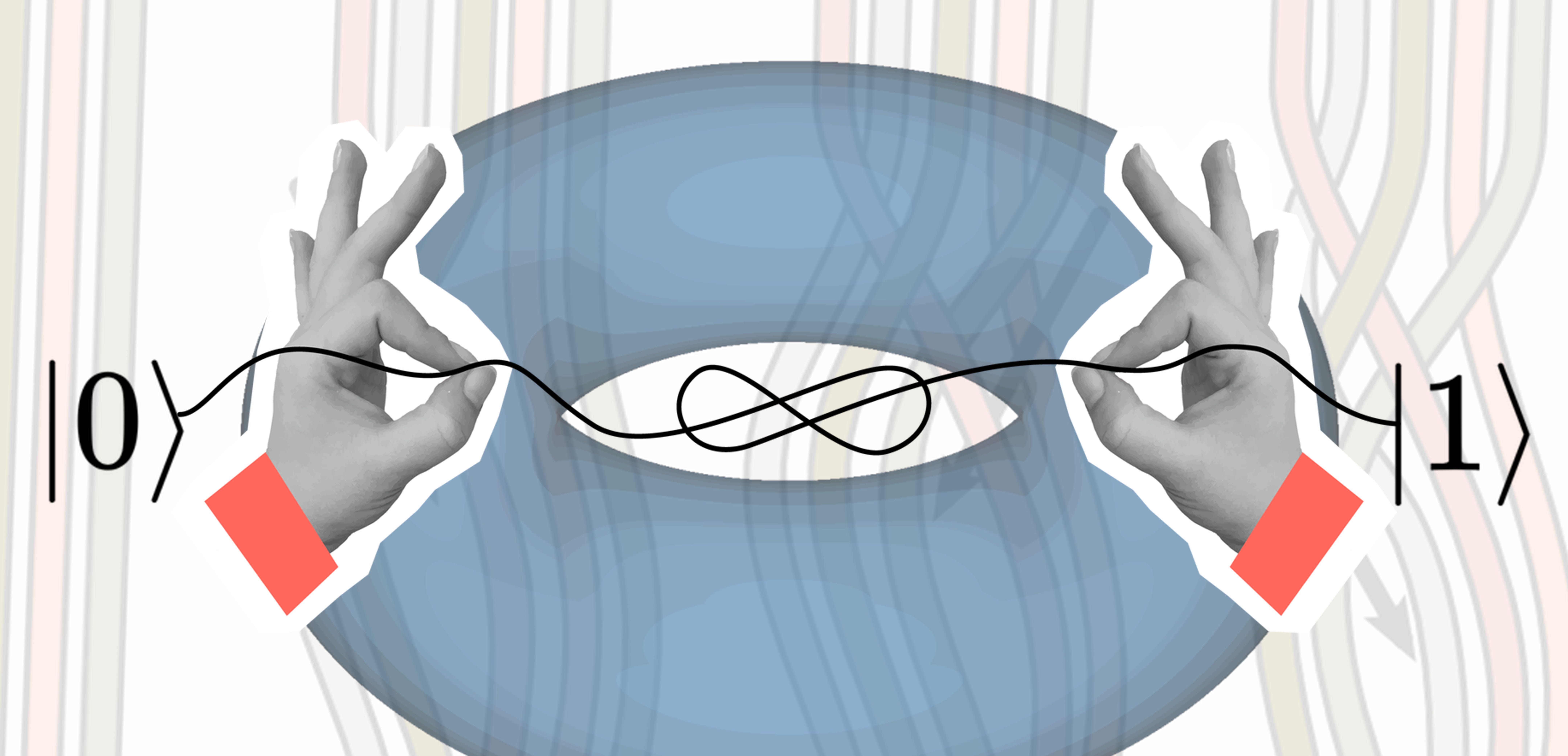
At the height of the Inca Empire in the Peruvian highlands of the 1500s, accountants, historians, and priests, had not a written language with which to govern and direct their society. Instead, information and data were recorded on knotted strings, known as quipus. The knotted cords were often made from cotton and could range from few to thousands on each device. By twisting and tying the strings of various fibres and colours, officials could take censuses, monitor taxes, and record annals. These devices were incredibly versatile - they were easily portable and storable as well as exceptionally sophisticated, transcending the spoken languages of the many groups subject to the empire.
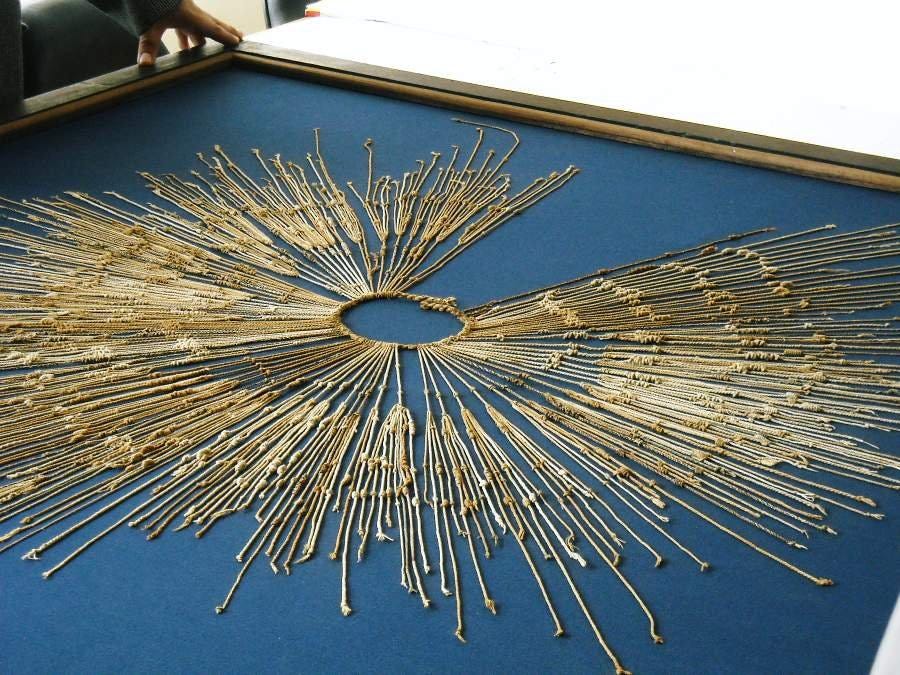
However, the school of the quipu ceased through the Andean conquest of the Spanish Empire. The church banned and burned many quipus in 1583, as they were considered idolatrous devices which recorded sacrifices to other gods. Today, it is not known how quipus are read, nor how many remain in existence.
In the modern day, we once again return to knots to store information robustly.
We currently live in an age where there is heavy investment into the design and research of quantum devices. While quantum computers are what people have in mind when they hear quantum devices, there are actually many other broad types of devices under development. For example, quantum sensors are tiny and exceptionally sensitive and precise, while quantum imaging technologies can see far better using less light - all enabled by leveraging unique quantum phenomena like entanglement and superposition. These are all fascinating applications, but how does one make a quantum device?
At their core, any quantum device must be based on an object that has quantum behaviour - whether that be an atom, a photon, or a more exotic object. This is what makes building quantum devices difficult. At the macroscopic level at which we live our lives, quantum effects are all but invisible - hence why it took so long to discover quantum theory, and why to some it seems unintuitive. Whether or not we notice quantum effects depends on the energy or scale of our observation compared to ħ, Planck’s constant:
This is an incredibly small number. For comparison, consider, for example, thermal fluctuations at room temperature. These fluctuations can induce energy changes of roughly
This may seem tiny compared to the 4.2 Joules needed to heat a gram of water, but in the timescale of say one second, this is about 4000000000000 times the energy scale of quantum effects, meaning that delicate quantum effects are immediately washed out in thermal noise. Any coherent quantum state is therefore constantly being jostled by an environment that does not respect the fine structure of quantum information. At room temperature, this destroys quantum systems in femtoseconds - even light, the fastest thing in the universe, can only travel micrometres, or roughly the length of a red blood cell, in this interval of time. This is why quantum behaviour disappears so quickly in macroscopic systems, and why it’s so hard to make devices that store quantum information.
So, how does one design a quantum device? We need a reasonably stable quantum object to form the basis for our qubits. These could be Rydberg atoms (heavy atoms that are electronically similar to hydrogen), photons, or even tiny electric currents. Each type of qubit has its own pros and cons, and there are many teams all over the world pursuing different directions on how to implement a quantum computer with these quantum systems.
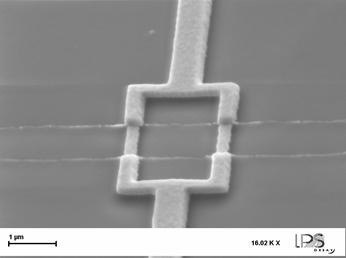
However, we will focus on a different underlying quantum system from the above. In particular, we will consider one that is quite special, having unique properties that may promise to make it far more robust than any of the other qubits.
The Standard Model of particle physics is believed to describe all of the fundamental fields that we see in nature. Inside this model, all particles fall into one of two types: fermions, which are matter particles; and bosons, which are force-carrying particles. For example, electrons, neutrinos, and quarks are all fermions which build up matter, while the photon and gluon mediate the electromagnetic force between charged particles and the strong force that binds together quarks, respectively.
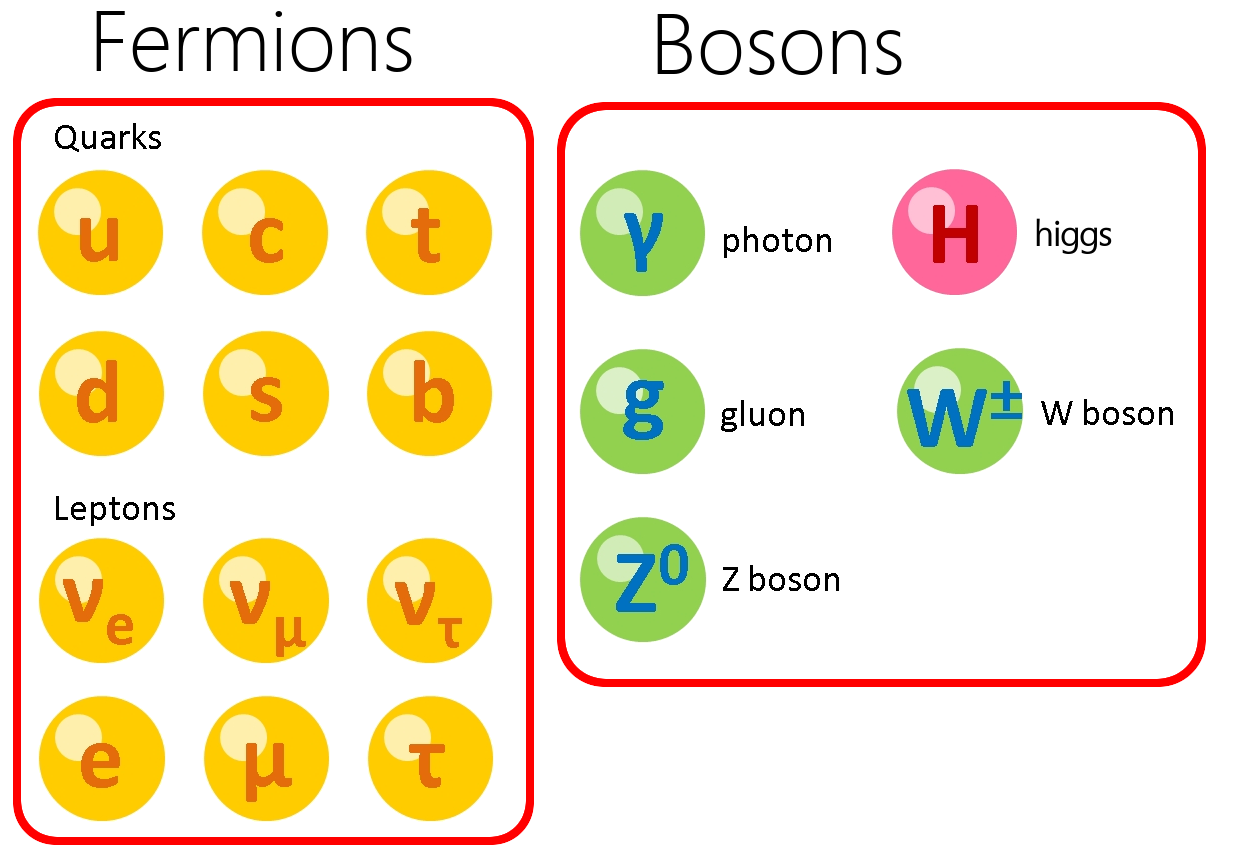
But why are there only these two classes of particles, bosons and fermions, and what makes them different?
One of the key properties of quantum particles is that they are indistinguishable. If I have, say, two particles with the same quantum numbers (e.g. spin), there is no way to label them with extra information to tell them apart. If I have the two particles in front of me, then look away and then back, there would be no way to tell if the particles are in their original position or if someone secretly swapped them while I wasn’t looking. They’re completely identical.
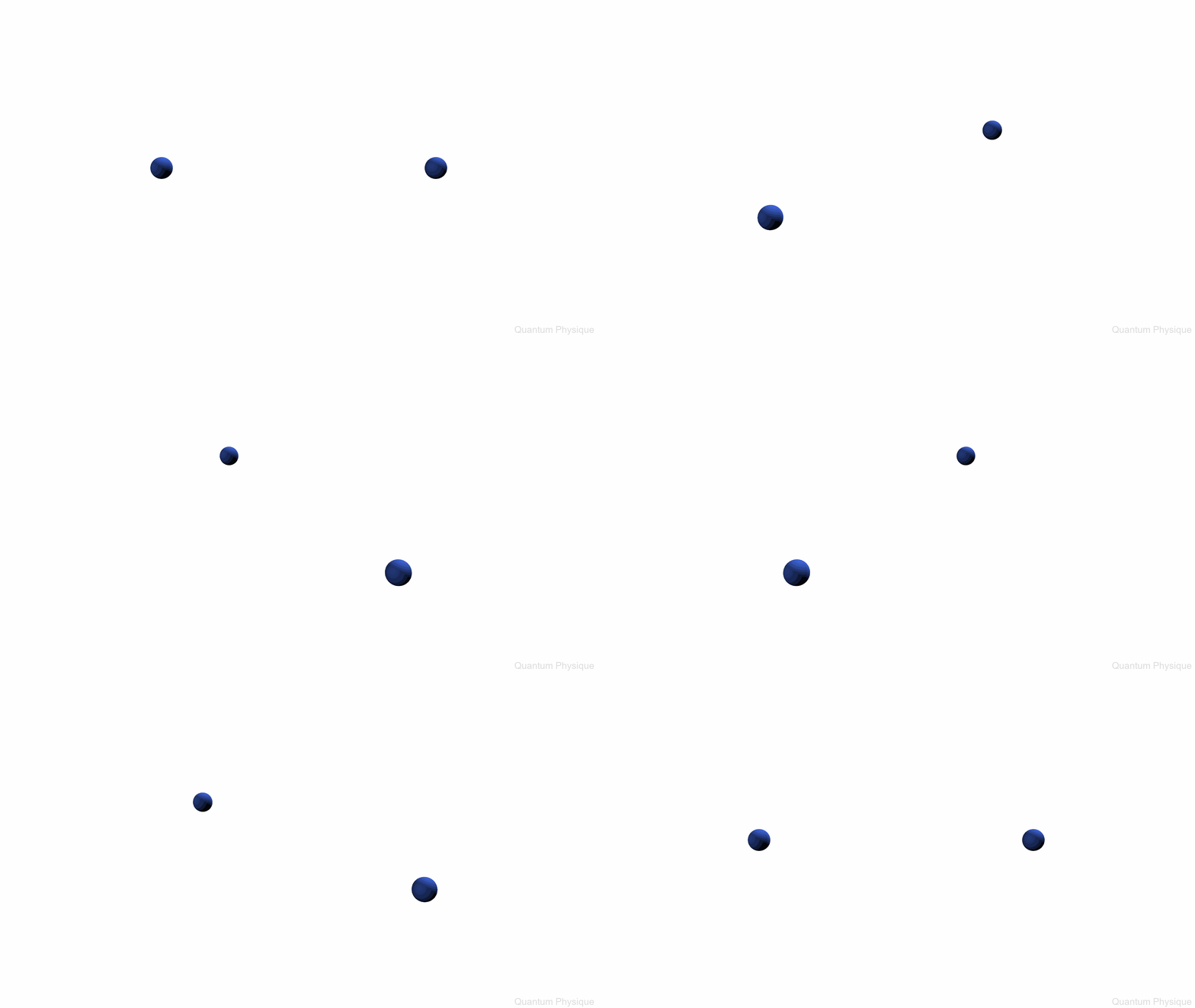
So, we shouldn’t really think of one as “particle A” and the other as “particle B”, since there is no way to tell which is which. Instead of trying to describe them individually, we should think in terms of a combined wavefunction Ψ(x,y) for both particles. What should this wavefunction look like?
Suppose we have two particles and we permute, or swap, them twice. Then, we should naturally expect that performing this operation should leave the wavefunction unchanged, since both particles are in their original positions. In other words, for the permutation P, we should expect
This leaves us with only two distinct possibilities for how a single permutation behaves:
This is because two permutations must be the same as doing nothing. This means we have two types of behaviours: swapping the particles once gives the same wavefunction, or swapping the particles once changes the wavefunction by a minus sign. In nature, both behaviours exist. In the first case, we call the particle a boson, and in the latter, we say the particle is a fermion. Explicitly, allowing for fictional labels, the wavefunctions can be built from the single-particle wavefunctions ψ(x),
One can easily check these transform in the expected way.
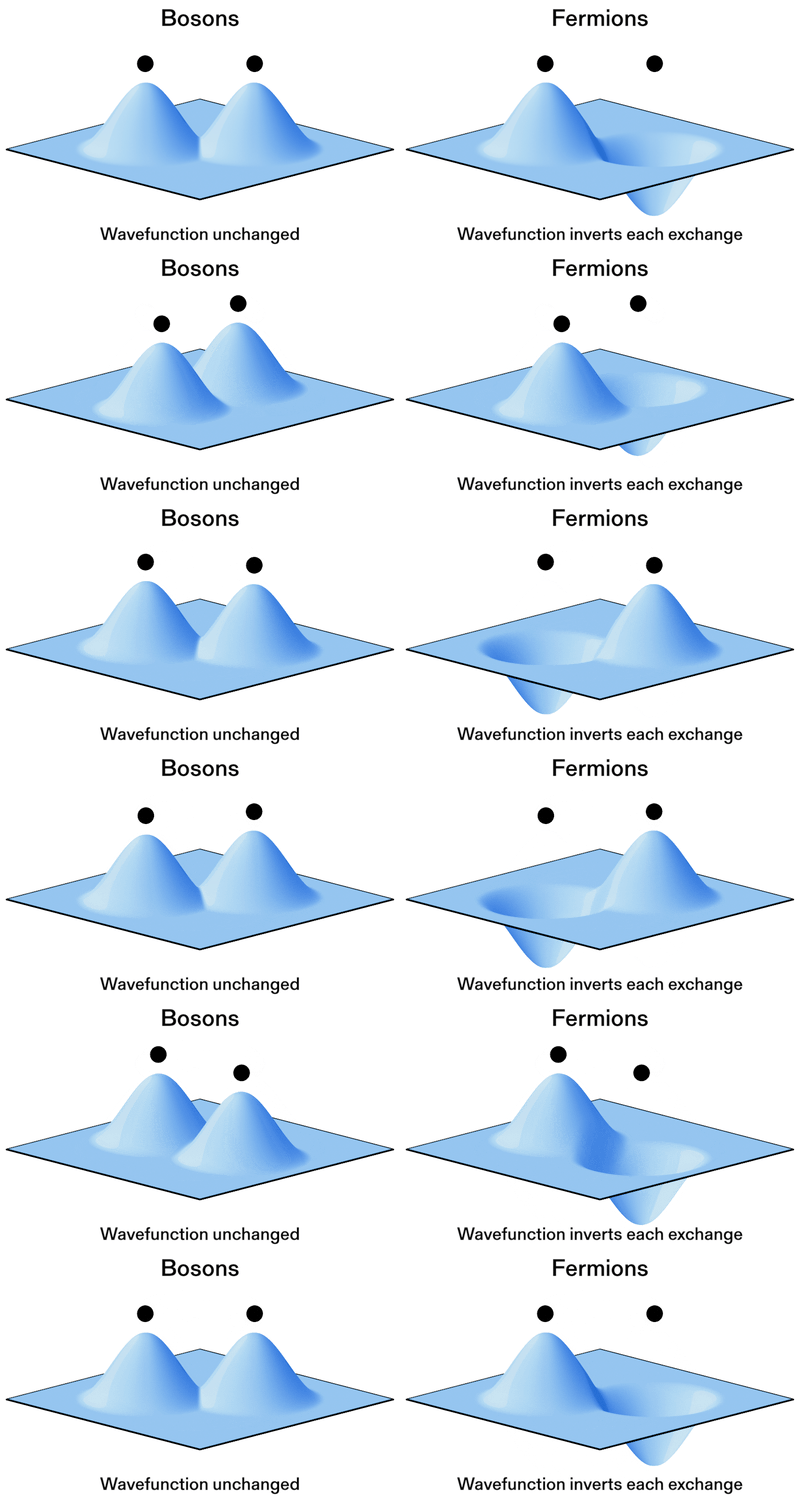
This fermionic rule has an important implication: if we try to take x=y, the wave function vanishes! This is the Pauli Exclusion Principle - we can’t have two identical fermions in the same position.
These are seemingly the only two possibilities. However, we should be a bit careful. Why is it true that permuting twice is the same as doing nothing? What we should do is consider the process of swapping around the particles as a function of time. Instead of points, we should think about the worldlines, or trajectories, of the particles as we swap them. As we drag the particles around each other to permute them, the worldlines appear to wrap around each other. This would seem to suggest that maybe our swaps do leave some imprint. But, because we live in 4=3+1D spacetime, we can actually continuously deform the worldlines of the permuted particles, making use of all four dimensions, back to just straight untangled paths. This means that performing the swap twice is topologically identical to not doing the swap.
If we trace out the worldline of particles while we swap them, what we see is really how a 2D spatial slice evolves in time, for example along z=0, of the full 3+1D=4D space. Suppose we push the path of the particles a little so they pass through z=1 for some duration. If we move to the z=1 slice, we can exactly untangle the lines without crossing them! We can then go back to the z=0 slice and push our particles back into this slice, and see that the worldlines are completely untangled.
However, in one dimension lower, this is no longer the case! For particles living in a surface, i.e. 3=2+1D, after performing the swap, the worldlines cannot be untangled! In other words, the paths are braided into knots. Instead of thinking about the group of permutations of the particles, we should think about the braid group. Since P2≠1, we can no longer separate these particles into bosons and fermions. Instead, we get exotic particles called anyons, i.e., they can acquire “any” phase after swapping, not just ±1:
Before showing exactly how these particles arise, let’s first try and understand why we can have any phase. Why not still some finite set of allowed angles? To answer this, we must delve into an area of mathematics that is incredibly important in physics: Representation Theory.